
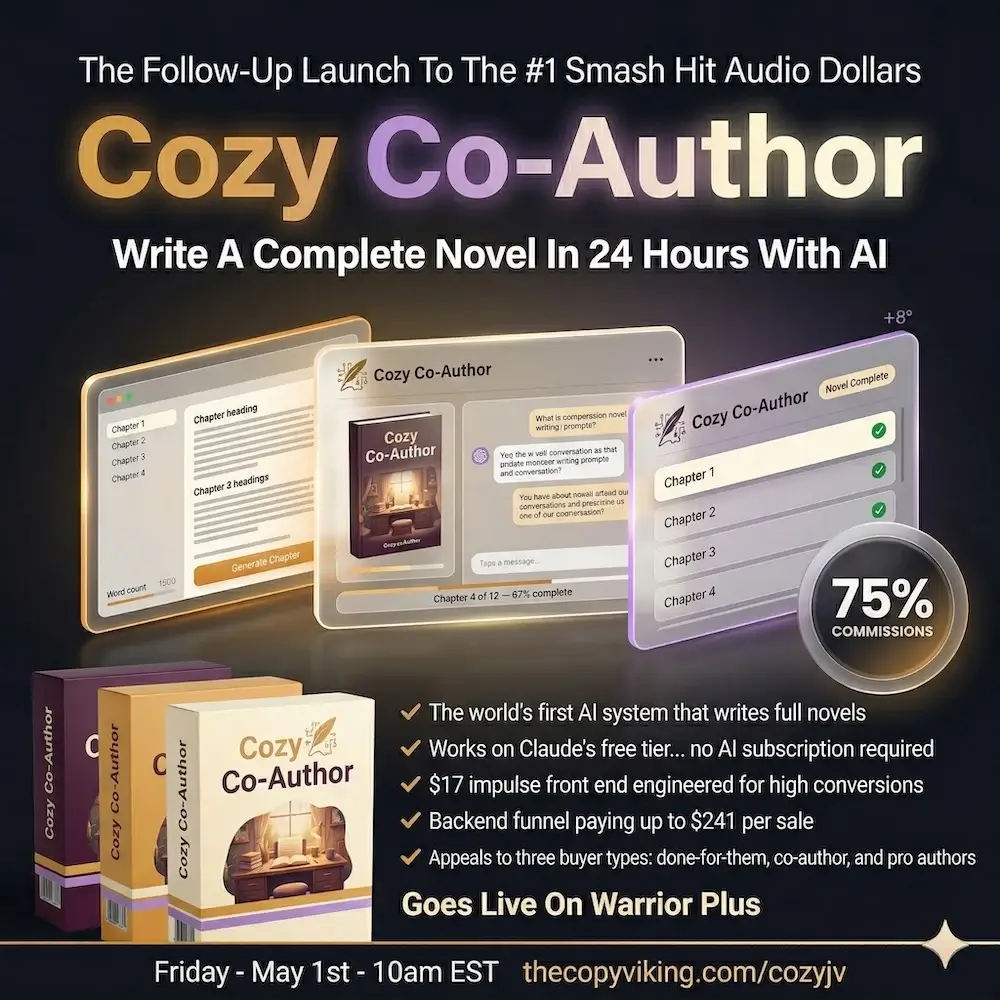
Cozy Co-Author is a two-file AI writing system built specifically for Claude that walks you through planning, drafting, and publishing a complete cozy fantasy novel for Amazon KDP. At a $27 front-end price with a 14-day refund window, it’s a low-risk way to test AI-assisted fiction writing, though turning a manuscript into actual royalties still depends on cover design, positioning, and promotion — not the framework alone.
If you’ve ever wanted to write a novel but stalled out somewhere around chapter three because nobody handed you a system that actually carries you to “The End,” that’s exactly the gap Cozy Co-Author is built to close.
This Cozy Co-Author review breaks down what the system actually does, how the two-file setup works inside Claude, what’s included in the front-end versus the upsells, who it realistically fits, and where its limits are — so you know exactly what you’re getting before you spend a dollar.

What Is Cozy Co-Author?

| Creator | Søren Jordansen (“The Copy Viking”) |
|---|---|
| Product | Cozy Co-Author |
| Built For | Claude (Anthropic) |
| Official Website | CLICK HERE |
| Front-End Price | $27 (one-time payment) |
| Bonuses | Yes, Check Below |
| Skill Level | All Levels (Beginner-Friendly) |
| Guarantee | 14-Day Money-Back Guarantee |
| Niche | AI Fiction Writing / Amazon KDP Publishing |
| Recommend | Worth a look for the right audience |
Cozy Co-Author is a guided AI fiction-writing system that turns Claude into a co-author for cozy fantasy novels. It’s not a single mega-prompt and it’s not a course full of theory — it’s two structured framework files plus a step-by-step training course built around them.
You don’t need prior writing experience. You don’t need to understand fiction structure, pacing, or genre conventions going in. The system supplies that scaffolding so Claude can do the heavy lifting while you make creative decisions along the way.
At a glance, the workflow looks like this:
- Load two framework files into a Claude conversation or project
- Answer a guided set of planning questions about your story
- Let Claude generate planning documents (story bible, character profiles, chapter outline)
- Write the novel chapter by chapter, reviewing as you go
- Follow the included training to format, publish, and promote on Amazon KDP
The system is narrowly focused on cozy fantasy — a genre defined by warmth, low stakes, small-town or magical settings, found family, and emotional comfort rather than conflict-driven plotting. That focus is intentional, and it’s also the system’s biggest constraint, which we’ll get into below.
Who Created Cozy Co-Author?
Cozy Co-Author comes from Søren Jordansen, a Denmark-based direct-response copywriter and digital product creator who goes by The Copy Viking in the WarriorPlus and JVZoo marketplaces. He’s released several products over the years, generally built around the same philosophy: take a complicated workflow, strip out the friction, and hand buyers something they can run on day one without a learning curve.
According to the product’s sales materials, Jordansen used this same two-file framework to write and publish a cozy fantasy trilogy called Whiskers & Wildwood under the pen name Kit Ellis, reportedly producing all three books in around 13 days. The sales page states the series reached Amazon category rankings and generated Kindle Unlimited page reads and royalties.
That’s a meaningful detail worth flagging clearly for transparency: these are the creator’s own claims about his own results, presented on his own sales page. We haven’t independently verified the sales figures, rankings, or royalty numbers, and no royalty outcome can be promised to any buyer using the same system. Individual results in fiction publishing depend heavily on execution — covers, blurbs, categories, pricing, and promotion all matter as much as the manuscript itself.
Read Also :- our ScribeLabs AI review
How Does Cozy Co-Author Work?
The system runs in three stages, and understanding each one tells you exactly what you’re paying for.
Step 1: Plan
You load both framework files into Claude and work through a guided set of roughly 14 creative questions — things like genre tone, protagonist type, setting, central relationship, and conflict style. Claude uses your answers to generate a set of planning documents:
- A Story Bible covering world rules, setting details, and tone
- Character profiles for the protagonist, love interest, found-family cast, and antagonist
- A chapter outline mapping the book’s structure from beginning to end
This planning stage exists to solve a real problem with AI-assisted long-form writing: without a fixed reference point, AI models tend to drift on character details, tone, and plot threads over a long document. Front-loading that structure is meant to keep the rest of the process consistent.
Step 2: Write
Once the planning documents exist, Claude writes the novel chapter by chapter rather than in one long dump. You read each chapter, give feedback, request changes, and approve before moving to the next one. The framework is designed to track continuity — keeping character voice, established facts, and plot threads consistent as the manuscript grows.
This chapter-by-chapter loop is the core mechanic that separates Cozy Co-Author from a generic prompt. A single prompt can produce a scene. Maintaining tone and continuity across 20+ chapters requires ongoing structure, which is what the framework is attempting to provide.
Step 3: Publish
The bundled training course then walks you through the publishing side: formatting your manuscript, building a cover, setting up your KDP account, choosing categories and keywords, pricing your book, and basic promotion strategy — including thinking about your first book as the start of a series rather than a one-off.

Cozy Co-Author Key Features
Two-File AI Writing System The entire framework runs on two files you paste into Claude — a setup/configuration file and a writing-framework file that drives the chapter-by-chapter process. There’s no software to install and no separate account to manage; everything happens inside your existing Claude conversation.
Guided Story Setup A structured sequence of creative questions, each with multiple options and explanations, shapes your story’s foundation before any writing begins — useful if you’ve never outlined a novel before and don’t know where to start.
Cozy Fantasy Framework The instructions are written specifically for the cozy fantasy genre, steering Claude toward warm pacing, low-stakes conflict, and character-driven scenes rather than generic fiction output that could land anywhere.
Structured Planning Documents You come out of the setup phase with a Story Bible, character profiles, and a chapter outline — concrete reference documents rather than a vague sense of “the plan.”
Chapter-by-Chapter Writing Flow Rather than generating an entire draft at once, the system produces the book one chapter at a time so you can course-correct early instead of discovering problems forty chapters in.
Continuity Tracking Built-in mechanisms aim to keep character details, plot points, and world facts consistent — addressing one of the most common failure points in long-form AI writing.
Prose Quality Guardrails The framework includes rules intended to reduce repetitive phrasing, filler text, and the kind of stiff, generic sentence patterns that make AI-written fiction easy to spot.
Training Course A multi-module course covers the full pipeline from idea to published book: planning, writing, editing, formatting, cover creation basics, KDP publishing mechanics, and promotion.
Series-Building Guidance Because cozy fantasy readers on Kindle Unlimited tend to binge series rather than read standalone titles, the training frames your first book as part of a larger plan rather than a finished destination.
Why Cozy Fantasy?
Cozy fantasy is a fiction subgenre that trades high-stakes conflict for comfort — think small-town settings, magical tea shops, found-family relationships, gentle pacing, and low-stakes problems that resolve warmly. It’s been one of the faster-growing fiction categories on Kindle in recent years, driven heavily by BookTok recommendations and reader appetite for low-anxiety escapism.
The genre fits Kindle Unlimited particularly well because cozy fantasy readers are known for binge-reading entire series rather than picking up single titles. That reader behavior is the entire business logic behind the product: one book is a project, but a series — if it connects with readers — can become a recurring income stream through page reads and follow-on sales.
That said, “growing genre” doesn’t mean “guaranteed audience for your specific book.” Competition in cozy fantasy has increased as more authors (AI-assisted and otherwise) have moved into the space, which makes cover quality, blurb writing, and category/keyword selection more important than ever for any new release to get found.
Cozy Co-Author Pricing and OTO Breakdown
The front-end is a one-time payment of $27, backed by a 14-day money-back guarantee. There’s no subscription required to use the core framework — it runs on Claude’s free tier, though a Claude Pro subscription may speed things up for high-volume writers.
Beyond the front-end, the funnel includes several optional upgrades:
| Upgrade | What It Does | Price |
|---|---|---|
| Cozy Genre Vault | Additional genre frameworks and expanded creative options beyond the core cozy fantasy template | $67 |
| Cozy Promo Stacker | Tools and templates aimed at promoting and marketing published books | $57 |
| Cozy Editor | Editing-focused framework to polish and refine manuscript drafts | $37 |
| Cozy KDP | Extended KDP publishing support and resources | $14.99/mo or $147/yr |
| $100M Copy AI | Copywriting framework add-on, unrelated to fiction specifically | $197 |
As with most one-time-payment digital launches, none of these upgrades are required to use the core two-file system. They add editing support, promotion tools, or extra genre frameworks on top of the base product.
Who Is Cozy Co-Author For?
Cozy Co-Author fits well for:
- Aspiring authors who’ve never finished a manuscript and want a structured path that carries them through
- Writers who’ve started and stalled repeatedly and need momentum more than inspiration
- Existing KDP publishers looking for a faster way to build fiction backlist assets
- Anyone already comfortable using Claude or similar AI tools who wants a stronger framework than ad hoc prompting
- Readers and fans of the cozy fantasy genre who want to create the kind of stories they already enjoy
It’s a weaker fit if you’re looking for a fully automated “click and publish” book generator with zero creative input, if you have no interest in the cozy fantasy genre specifically, or if you’re unwilling to handle covers, editing review, and promotion — none of which the core framework does for you.
Pros and Cons
Pros:
- Beginner-friendly — no fiction-writing background required
- Low one-time entry price with a 14-day guarantee
- Built specifically for Claude, with no required subscription for the core system
- Goes beyond prompts to provide structure across an entire novel
- Chapter-by-chapter flow keeps you in control of direction and pacing
- Includes publishing training, not just a writing framework
- Encourages series thinking, which fits how cozy fantasy readers actually consume books
Cons:
- Narrowly focused on one genre — cozy fantasy specifically
- No system can guarantee rankings, page reads, or royalties
- Final book quality still depends on your review, editing, and creative choices
- KDP success requires cover design, categorization, and promotion that the core framework doesn’t handle
- The upsell funnel adds several optional purchases on top of the front-end
Is Cozy Co-Author Worth It? Final Verdict
Cozy Co-Author earns its place as a genuinely structured entry point into AI-assisted fiction writing, particularly for people who’ve tried and failed to finish a novel on their own. It directly addresses the biggest blocker in long-form AI writing — consistency breaking down over many chapters — by front-loading planning documents and maintaining continuity chapter by chapter.
That said, no system, including this one, can manufacture an audience, guarantee Amazon rankings, or promise royalties. Treat it as a structured production framework, not a passive income machine. If you’re genuinely interested in cozy fantasy as a genre and want a guided path from blank page to published KDP book, it’s worth a serious look at this price point — just go in with realistic expectations about the publishing and promotion work that still falls on you.
Read Also :- the MagicBooks AI review

FAQ SECTION
Q1: Do I need writing experience to use Cozy Co-Author? No. The system is built for people with zero fiction-writing background. The guided setup questions and planning documents handle the structural decisions, so you focus on creative choices rather than technical story craft.
Q2: Do I need a Claude subscription to use this? No subscription is required for the core framework — it runs on Claude’s free tier. A Claude Pro subscription may help if you’re writing multiple books or want faster, less-throttled sessions, but it’s not mandatory.
Q3: How much does Cozy Co-Author cost? The front-end is a one-time payment of $27 during the current pricing period, with no recurring fees for the core system. Optional upgrades in the funnel range from $37 to $197, plus one subscription-based add-on.
Q4: Is there a money-back guarantee? Yes. Cozy Co-Author includes a 14-day money-back guarantee on the front-end purchase, giving you time to try the planning and writing process before committing long-term.
Q5: Can I write genres other than cozy fantasy with this system? The core framework is built specifically for cozy fantasy. Some upsells expand into additional genre options, but the front-end product is intentionally narrow and focused on this one genre.
Q6: How does this avoid the “obviously AI-written” feel? The framework includes built-in prose guardrails aimed at reducing repetitive phrasing, filler language, and stiff sentence patterns common in unstructured AI writing. Final quality still depends on your review and editing before publishing.
Q7: Does Cozy Co-Author guarantee I’ll earn royalties on KDP? No. No tool can guarantee sales, rankings, or royalties. The system provides a structured path to a finished manuscript and basic publishing guidance, but results depend on execution — covers, categories, pricing, and promotion.
Q8: How long does it take to write a novel with this system? The creator’s own case study describes producing a trilogy in around 13 days, but timelines vary widely based on how much time you dedicate per day and how much editing and revision you do along the way.
Q9: What exactly are the “two files” in the system? One file configures Claude’s tone, voice, and genre rules for cozy fantasy. The second file runs the actual planning sequence and chapter-by-chapter writing process. Together they function as the operating system for the novel.
Q10: Does the training course cover publishing, or just writing? Both. The included training walks through planning, writing, editing basics, formatting, cover guidance, KDP account setup, pricing, and promotion — not just the manuscript stage.
Q11: Is this beginner-friendly for someone who has never used Claude before? Yes. The setup is designed to be copy-paste simple — you add the files to a Claude conversation and answer guided questions. No technical or AI experience is required beyond basic copy-and-paste.
Q12: Are the OTO upgrades required to use the core system? No. The front-end purchase includes the complete two-file writing system and training course. The OTOs add extra genre frameworks, editing tools, promotion resources, or an unrelated copywriting add-on, but none are mandatory.
Q13: Is Cozy Co-Author a good fit if I want to publish multiple books quickly? It’s built with that use case in mind — the training specifically frames series-building as the path to sustainable income on Kindle Unlimited, since cozy fantasy readers tend to binge entire series rather than single titles.

Dane Morrison
I’m Dan Morrison. After spending 20 years in a 9–5 job and failing multiple side hustles, I finally cracked the code to building income online.
Today, I help beginners avoid scams and learn proven online income systems using affiliate marketing and digital assets.
If you’re serious about changing your financial future, you’re in the right place.
- TokNinja AI Review 2026: The Ultimate AI-Powered TikTok Shorts Machine That Creates Viral Content On Autopilot August 29, 2026
- ProfitBOT Review: Is This "60-Second AI Business" Really Worth $17? August 29, 2026
- AI UGC Hub Review: Turn Any Product Link Into A Ready-To-Post UGC Video In Minutes August 18, 2026
- Best AI Models Review : All Latest Models in One DashBoard August 5, 2026
- Best AI Tools for Small Businesses Under $50/Month August 1, 2026
Our Fact Checking Process
We prioritize accuracy and integrity in our content. Here's how we maintain high standards:
- Expert Review: All articles are reviewed by subject matter experts.
- Source Validation: Information is backed by credible, up-to-date sources.
- Transparency: We clearly cite references and disclose potential conflicts.
Our Review Board
Our content is carefully reviewed by experienced professionals to ensure accuracy and relevance.
- Qualified Experts: Each article is assessed by specialists with field-specific knowledge.
- Up-to-date Insights: We incorporate the latest research, trends, and standards.
- Commitment to Quality: Reviewers ensure clarity, correctness, and completeness.
Look for the expert-reviewed label to read content you can trust.