
Building a YouTube channel without ever turning on your camera sounds great, right? With the right Faceless YouTube Channel Creator AI setup, it stops being a fantasy and becomes a repeatable system you can run like a small media business.
The catch is that you can’t just toss scripts into a tool and hope for viral hits. To make faceless content actually work, you need a clear strategy, a smart tech stack, and a realistic workflow that fits your time and budget. This guide walks you through how to design that system from scratch and scale it without burning out.
What Faceless YouTube Channel Creator AI Actually Does For You
A solid Faceless YouTube Channel Creator AI approach doesn’t just “make videos”; it helps you plan topics, write scripts, produce visuals, and publish on a schedule you can sustain. Think of it as building a small team made of tools instead of freelancers.
Instead of staring at a blank page or struggling with on-camera delivery, you can focus on picking angles, approving scripts, and tracking performance while the tech handles the busywork.
Read Also :- Our Youtube Superstar Review
Key parts of a faceless AI-powered workflow
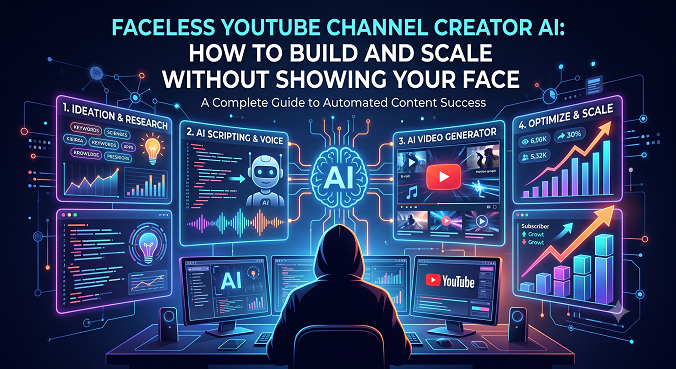
The first layer is ideation: tools help you find keywords, angles, and questions real viewers are asking so your content isn’t based on guesses. From there, you move into scripting, voice, visuals, and editing in a predictable sequence.
Once those building blocks are in place, you can map out a weekly or monthly production calendar and know exactly what has to happen each day to keep your uploads consistent.
Where AI helps and where it doesn’t
An AI YouTube Video Generator can speed up the draft stage for scripts and even propose B-roll ideas, but it still needs a human to check tone, facts, and story flow. Treat it as a smart assistant, not a replacement for your judgment.
AI won’t fix a weak niche, a confusing audience, or a boring concept, so you still need to make deliberate choices about who you serve and why they should care.
Choosing a Profitable Niche for Your Faceless Channel
Before you obsess over tools, you need a niche that can support many videos without running out of ideas. A focused niche also helps any Faceless AI Video Creator stay on-brand because you can feed it clearer prompts and examples.
Look for topics where people search for how-tos, comparisons, or explanations, because those formats adapt well to faceless content built around screen recordings, stock footage, or motion graphics.
How to validate your niche with data
Start by collecting 30–50 potential topics and search phrases, then check search volume and competition in a keyword tool so you’re not guessing. This is where AI YouTube Automation shines, because you can plug those topics into templates to outline scripts quickly.
Pay attention to the channels already winning in your space, and note video length, style, posting frequency, and which thumbnails seem to pull the most views.
Once you’ve confirmed there’s proven demand, zoom in further and pick a specific content angle so you’re not just another generalist channel chasing everything and winning nothing.
Designing a Simple AI Production Pipeline
A reliable pipeline turns “I should upload more” into “this is what gets done every Tuesday.” That pipeline is where a good AI Faceless Video Generator starts to feel like an engine instead of a toy you play with once.
Think of your pipeline as a straight line: research → script → voice → visuals → edit → upload → optimize. Each step is handled by either you, a tool, or a repeatable checklist.
From text to video with minimal friction
Once your script is ready, a YouTube Automation AI can pair it with voiceover, scenes, and transitions using templates, which dramatically cuts down on editing time for repeatable formats like listicles and explainers.
You can still jump into your editor to tighten pacing, adjust timing, or swap in better clips, but you’re no longer manually building every scene from a blank timeline.
If you prefer to start from an article or outline, a Text to YouTube Video AI can break paragraphs into scenes and suggest where to place callouts, captions, and pattern interrupts that keep watch time high.
What a weekly workflow might look like
On Monday, you batch keyword research and pick titles; on Tuesday, you draft and edit scripts; on Wednesday, your AI Video Creator for YouTube turns those approved scripts into rough cuts you can fine-tune.
Later in the week, you finalize thumbnails, descriptions, and end screens, then schedule uploads so your channel stays active even when you’re busy with other work.
Optimizing Faceless Videos So They Actually Get Views
Publishing isn’t enough; you need to help the algorithm understand who your videos are for. Smart faceless YouTube channel automation relies on repeatable systems for titles, thumbnails, and descriptions that you continually improve.
Over time, you’ll spot patterns: certain intro hooks keep viewers longer, some visual styles make people click faster, and specific calls to action drive more subscribers or affiliate clicks.
Title, thumbnail, and retention basics
Spend real time on titles and thumbnails, because they decide whether your video ever gets a chance to be watched and judged by the algorithm. Your Faceless YouTube Channel Creator AI stack can suggest options, but you should still test variations.
Inside the video, front-load the value, avoid long logo reveals, and use frequent visual changes so people don’t feel like they’re staring at the same static scene for minutes at a time.
As data comes in, track click-through rate, average view duration, and watch time to decide which experiments to double down on and which to quietly drop.
Scaling Up: From One Channel to a Small Faceless Empire
Once your first channel runs smoothly, scaling isn’t about doing more random experiments, it’s about cloning a working system and adapting it. Faceless YouTube Channel Creator AI tools make that possible because you can templatize almost every step.
Before starting a second channel, make sure the first one has a proven format, at least a few videos with clear traction, and a workflow that doesn’t depend on you handling every single task.
Building a tiny “virtual team” with AI
Use a Faceless YouTube Channel Creator AI as your script assistant, a separate tool as a research helper, and another for design so you’re not forcing one platform to do everything badly.
The best AI Tool for Faceless YouTube Channels is the one that plugs neatly into your system, lets you work in batches, and doesn’t break when you increase production volume.
As you grow, you can bring in human help for quality control, research, or thumbnail design while AI keeps the process fast and affordable.
Ready to Build Your Next Faceless Channel?
If you treat this as a real media operation instead of a quick hack, a thoughtful Faceless YouTube Channel Creator AI workflow can help you produce consistent videos, test formats faster, and grow without ever stepping in front of a camera.
Start by picking a clear niche, mapping a simple pipeline, and trying one or two tools instead of ten, then refine based on real data and, when you’re ready, use Ai Buyer Guide to compare the smarter options on the market for your next upgrade.
