
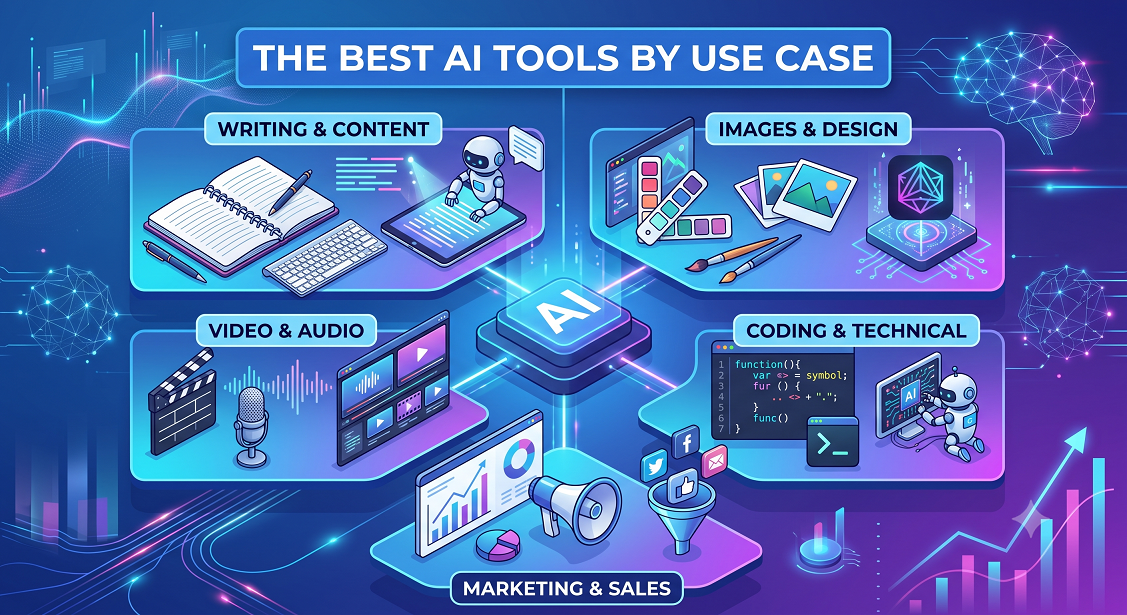
If you only remember one thing about AI, make it this: the tools matter less than matching the right tool to the right job. The teams getting real results aren’t using more software; they’re picking the best AI tools by use case and building simple, repeatable workflows around them.
This guide walks through the best AI tools by use case across writing, images, video, coding, and marketing, so you can stop guessing and start building an AI stack that fits how you actually work.
How to Think About AI Tools by Use Case
Before you start signing up for every shiny product, it helps to group AI software by category so you see where each one fits in your day. Think of your stack like a toolbox: you don’t need ten hammers; you need a hammer, a drill, and a level that each do one thing well.
The best AI tools are the ones that slide into your existing workflows with minimal friction. If you write reports, design decks, ship code, or manage campaigns, your goal is to identify the 2–3 tools that remove the most annoying work from each of those jobs.
Best AI Tools for Writing and Content
Most teams start with AI tools for writers because content is where the manual work piles up fast. Drafting, outlining, repurposing posts, and fixing tone can eat entire days if you do it all from scratch.
A practical setup is to use one main writing assistant for drafting, plus a second tool focused on editing for clarity and voice. That way you avoid the bland, generic feel that comes from relying on only one model for everything.
Use Cases: From Ideas to Finished Drafts
For brainstorming, you want AI productivity tools that help you move from blank page to structured outline quickly. Use them to map sections, headlines, and key arguments before you write a single sentence.
Once the structure is clear, have the writing tool create a rough draft, then you step in to add examples, stories, and specific data. Treat the output as a starting point, not a final article.
Editing, Repurposing, and Consistency
After drafting, AI tools for business communication can tighten emails, standardize tone, and remove filler while keeping your perspective intact. This alone can save hours every week for client-facing roles.
You can also use a specialized tool to turn one long article into shorter posts for social channels, internal newsletters, or client updates, so every piece of content does more than one job.
Best AI Tools for Images and Design
Visual work used to mean endless back-and-forth with design teams, even for simple assets. Now, AI tools for designers can turn text prompts into mockups, social graphics, and concept art in minutes, which is especially helpful for early-stage ideas.
The key is to treat visuals generated by these tools as drafts you refine, not final artwork. Designers can then focus on layout, brand feel, and higher-level creative decisions instead of repetitive production work.
Practical Image Workflows
One efficient workflow is to generate several rough concepts from a brief, then pick the top two for a designer to polish. That lets you explore more options without extending timelines or budgets.
Another common pattern is using AI to resize and adapt a single primary visual into platform-specific versions, so you’re not manually recreating the same banner for every placement.
Best AI Tools for Video and Audio
Video teams are using AI to cut down on editing time and make more content from the same raw footage. Tools can now auto-generate subtitles, social clips, and even B-roll suggestions directly from a long recording.
Creators who record talking-head videos often rely on AI to remove silences, tweak pacing, and clean audio, turning a single take into a polished clip that’s ready to publish.
Repurposing Long-Form Content
One smart use of AI tools for students is turning recorded lectures or webinars into short, topic-based segments. Those clips can then be shared in class forums or study groups for easier review.
Teams doing customer interviews can feed transcripts into a summarizer that flags key themes, quotes, and action items, so nothing important gets lost in hours of raw footage.
Best AI Tools for Coding and Technical Work
For engineering teams, AI tools for developers are most helpful when they sit inside the editor, suggesting code, tests, and documentation in context. This shortens feedback loops and lets developers stay in flow while they work.
These assistants shine on boilerplate, migrations, and refactoring, which frees senior engineers to spend more time on architecture, performance, and code reviews that still need human judgment.
From Idea to Working Prototype
AI can draft stub functions, suggest data structures, and outline APIs, so you can move from idea to basic prototype very quickly. That’s especially useful during discovery sprints or hackathons.
At the same time, you should pair AI automation tools with strict code review rules, test coverage, and security checks so generated code doesn’t quietly introduce new problems.
Best AI Tools for Marketing and Sales
On the go-to-market side, AI tools for marketers help with three big jobs: research, content, and reporting. The goal isn’t to replace strategy but to do the repetitive parts faster so you can spend more time on positioning and messaging.
For research, marketers use AI to summarize competitor sites, pull out key value props, and scan reviews for patterns, which turns a mountain of raw data into a usable brief for campaigns.
Campaigns, Copy, and Reporting
Once you’ve nailed the strategy, AI can suggest email subject lines, ad variants, and landing page copy so you can test more angles without adding extra writing hours.
On the performance side, many teams now set up AI tools for business analysis that turn analytics exports into clear narratives, showing what worked, what didn’t, and where budget should move next.
Choosing and Organizing Your AI Stack
With so many products competing for attention, it helps to start from use cases rather than logos. Many leaders literally map their workflows on one page, then slot in AI software by category instead of chasing every new feature release.
From there, aim for a small, tight stack: one writing tool, one image or design tool, one coding assistant, and one general-purpose assistant that ties everything together.
- List the top five tasks you repeat every week.
- Mark which parts are rules-based or pattern-heavy.
- Test one tool on one task for a full week before expanding.
- Keep a simple log of time saved and quality impact.
This kind of disciplined approach makes it easier to see where AI tools for business actually move the needle versus where they just add more complexity.
As your stack matures, you can gradually introduce more specialized AI tools for marketers, designers, or support teams as needed, rather than all at once.
The Bottom Line on Picking the Best AI Tools by Use Case
If you remember the core idea, you’ll avoid most mistakes: choose the best AI tools by use case, not by hype. Start with the work you already do, plug in one or two tools per job, and keep what clearly saves time without hurting quality.
As you refine your stack, treat every tool as replaceable and every workflow as an experiment, and use resources like Ai Buyer Guide to compare options before you commit budget or process to anything new.
